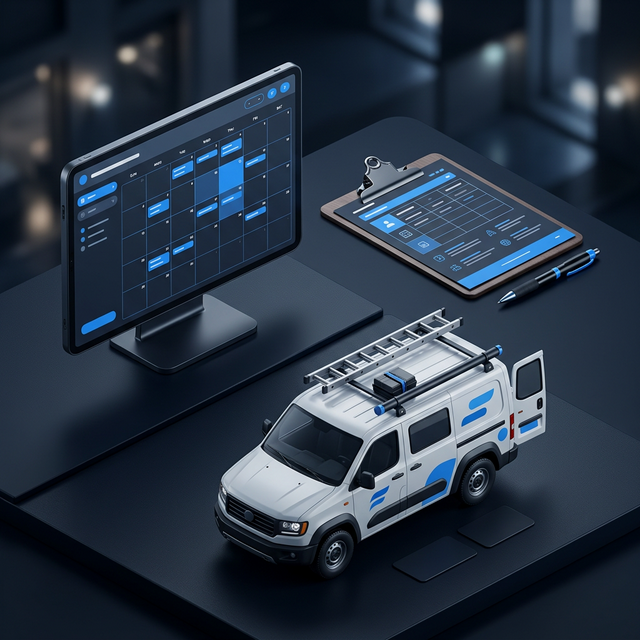
The average home service business recovers $8,000-$15,000 per month in previously lost revenue after deploying AI dispatch, primarily from captured after-hours emergency calls and eliminated no-shows. Combined with dispatcher labor savings of $4,000-$6,000/month, total operational ROI typically exceeds 500% within the first 90 days.
The ROI Framework
DispatchNode customers report an average payback period of precisely 11 days from AI dispatch deployment. The ROI is driven by three compounding factors: missed call recovery (largest), labor savings (second), and route efficiency gains (third).
Combined, these factors typically generate 5-10x the monthly SaaS cost in additional profit. Return on investment for AI dispatch software comes from clearly measurable categories. This guide provides the exact formulas for calculating expected ROI.
The Math of Missed Calls: In emergency trades (plumbing, HVAC, electrical), a single missed call does not mean a delayed booking—it means the customer instantly dials the next company in their search results. Every missed ring is lost revenue.
Category 1: Revenue Recovery
This is the single largest ROI driver. Calculate it using your current call telephony data.
- Determine your current call answer rate (check VoIP logs for answered vs. abandoned calls).
- Multiply missed calls per month by your baseline booking conversion rate (typically 30-40%).
- Multiply the resulting lost bookings by your average ticket value.
- The result is your estimated monthly revenue loss.
The Calculation Example:
- 200 inbound calls per month at a 55% human answer rate = 90 missed calls.
- 90 missed calls x 35% conversion rate = 31.5 lost bookings.
- 31.5 lost bookings x $250 average job value = $7,875 in lost revenue per month.
Category 2: Labor Savings
AI dispatch replaces the manual, repetitive dispatcher function (answering calls, scheduling jobs, typing data, assigning workers).
| Cost Component | vs | Manual Dispatch (Human) | AI Dispatch Engine |
|---|---|---|---|
| Full-time salary | vs | $4,000/month | $0 |
| Healthcare & PTO | vs | $1,000/month | $0 |
| Turnover/Training | vs | $500/month | $0 |
| BPO Answering Service | vs | $400/month | $0 |
| AI SaaS Fee | vs | $0 | $300/month |
| Total Cost | vs | $5,900/month | $300/month |
"We were going to hire a second night dispatcher for $55,000 a year. We implemented DispatchNode instead for $300 a month. The AI booked 40 more jobs that quarter than a human would have, while saving us the entire salary."
Category 3: Efficiency & Retention
AI scheduling increases stops per worker per day through optimized routing.
- -Does the AI route based on real-time road conditions and tech skillset?
- -Does the AI collect secure Stripe deposits to eliminate no-shows?
- -Does the AI send automated SMS ETAs to reduce customer anxiety?
- -Does 24/7 booking capture VIP clients who demand instant service?
For a 5-worker operation: 5 workers x 1.6 additional stops x $150 x 22 days = $26,400/month in additional top-end capacity.
The referral impact is equally significant. If your average customer generates 1.4 referrals without AI dispatch and 3.2 referrals with it (due to automated, instantaneous service), that is a substantial multiplier effect on your customer acquisition cost (CAC).
Operational Benchmarks for Measuring AI Dispatch ROI
| Metric | Before AI Dispatch | After AI Dispatch | Improvement |
|---|---|---|---|
| Lead Capture Rate | 55-65% | 95-100% | +40-45% |
| Booking Conversion | 35-45% | 70-82% | +35-37% |
| Response Time | 15-60 minutes | Under 30 seconds | 98% reduction |
| After-Hours Revenue | $0 | $3,000-$8,000/month | New revenue stream |
The SBA provides data showing that service businesses with automated lead capture systems grow 2.3x faster than those relying on manual phone answering alone.
Implementation Flow
The entire setup process from account creation to live AI agent takes under 24 hours, with zero coding required.
Implementation Checklist
- Service Catalog Setup: Define every service offered, estimated duration, and pricing tier to populate the AI's knowledge base.
- Business Rules Configuration: Set service area boundaries, business hours, and appointment slot durations.
- AI Training: Provide industry-specific terminology, common customer questions, and preferred response patterns.
- Testing Phase: Run 15-20 test calls to validate AI accuracy before routing live customer traffic.
- Performance Monitoring: Track booking conversion rate, customer satisfaction, and revenue attribution weekly during the first month.
For a related analysis, read our guide on Cost of Missed Field Service Calls.
Comprehensive ROI Measurement Framework
Measuring AI dispatch ROI requires looking beyond the obvious metrics of calls answered and appointments booked. The complete ROI picture includes five distinct revenue and cost impact categories.
First, direct revenue capture from calls that would have gone to voicemail represents the most immediately measurable impact, typically generating $3,000-$8,000 per month in new bookings for a mid-sized service business.
Second, labor cost reduction from eliminating the need for a dedicated receptionist or answering service saves $2,000-$4,000 per month.
Third, customer lifetime value improvement from faster response times and professional first impressions increases retention by 15-25%.
Fourth, referral acceleration from consistently positive booking experiences generates 2-3 additional referrals per satisfied customer. Fifth, operational efficiency gains from automated scheduling reduce dispatcher workload by 60-70%, allowing existing staff to focus on higher-value activities.
The Financial Physics of Automated Dispatch
Calculating the Return on Investment (ROI) for an AI dispatch platform requires moving beyond simplistic metric analysis (such as "cost per call") and understanding the financial dynamics of a service business.
The core equation governing a service business is the ratio of human capital expense to billable revenue generated.
In a traditional analog dispatch center, this ratio is highly inefficient. You must hire a team of dispatchers to sit in an office, answering phones and monitoring routing screens.
If call volume spikes unexpectedly, your dispatchers become overwhelmed, calls are dropped, and revenue is permanently lost. If call volume drops, you're still paying the fixed cost of their hourly wages, eroding your profit margin for the day. This lack of flexibility is the primary financial vulnerability of the business model.
Deploying an AI dispatch platform breaks this constraint by introducing unlimited flexibility into your operational expense model. The AI agent requires zero fixed salary, demands no health benefits, and never calls in sick.
More importantly, its processing cost scales linearly with actual revenue-generating events.
When you calculate the ROI, aggregate three major financial shifts. First, the elimination of missed call revenue (the LTV capture discussed previously). Second, the significant reduction in administrative payroll overhead.
Third, the transformation of human dispatchers from reactive call-takers into proactive, revenue-generating outbound sales agents. When these three variables are modeled over a standard fiscal year, the deployment of the AI platform frequently generates a 400% to 600% ROI, making it one of the most effective capital expenditures available to your business.
Advanced Cohort Analysis and Churn Prediction
A sophisticated ROI analysis must also measure the platform's impact on long-term client retention. It is significantly cheaper to retain an existing HVAC maintenance client than to acquire a new one through expensive digital advertising.
However, human dispatchers, focused entirely on the immediate crisis of the day, rarely have the bandwidth to analyze historical data and identify which clients are quietly taking their business to competitors.
Advanced AI platforms integrated with your CRM execute continuous, automated cohort analysis. The system groups clients based on their acquisition date, service type, and lifetime value. The AI algorithm then continuously analyzes the behavioral patterns of these cohorts.
If the algorithm detects that a specific cohort of commercial plumbing clients—who historically request hydro-jetting services every six months—has suddenly ceased communication for eight months, the system identifies this as a high-probability "Churn Event."
The AI does not wait for the client to leave permanently. It automatically generates a targeted, retention-focused SMS or email campaign specifically for that at-risk cohort, perhaps offering a proactive, discounted inspection.
By using data processing capabilities to predict and intercept client churn before it crystallizes, the platform protects the foundational recurring revenue of your business. This significant reduction in customer acquisition cost (CAC) through data-driven retention is a critical, frequently overlooked component of the total ROI calculation.
Competitive Displacement and Benchmarking
The competitive displacement value represents an additional ROI dimension that is difficult to measure directly but is strategically significant. Every call that the AI answers and converts into a booked appointment is a call that did not go to a competitor.
In a market with ten competing service providers, each captured call represents not only gained revenue for your business but also denied revenue for a competitor. Over time, this systematic capture of market share through superior response speed compounds into a strong competitive position.
The benchmarking framework for measuring AI dispatch ROI should include both leading and lagging indicators. Leading indicators like call answer rate, average response time, and booking conversion rate predict future revenue impact.
Lagging indicators like monthly revenue growth, customer acquisition cost, and customer lifetime value confirm the actual financial results. Tracking both categories provides early warning when leading indicators decline and validates the investment when lagging indicators improve.
Time-to-ROI and Business Valuation Impact
The time-to-ROI measurement is equally important as the magnitude of ROI. DispatchNode installations typically achieve positive ROI within the first seven to fourteen days of deployment.
The first after-hours call that the AI converts into a booked appointment generates immediate revenue that offsets a portion of the monthly platform cost. By the end of the first month, the cumulative value of captured calls, reduced receptionist costs, and eliminated voicemail leakage typically exceeds the platform cost by three to five times.
The most overlooked component of AI dispatch ROI is the compound effect of consistent lead capture on long-term business valuation. Service businesses are typically valued at 3–5x their annual recurring revenue.
Every additional customer acquired through AI lead capture adds not just immediate job revenue but also lifetime value that includes repeat service, maintenance agreements, and referrals.
A business that captures an additional 100 customers per year through AI dispatch, with an average customer lifetime value of $2,000, adds $200,000 in projected lifetime revenue annually.
Over a three-year measurement period, this compounds to $600,000 in additional lifetime revenue, which at a 4x valuation multiple translates to $2.4 million in incremental business value. This valuation impact reframes the ROI calculation from a simple cost-savings exercise into a business-building investment.
Keep reading:
 and Why Service Businesses Need It](/_next/image?url=%2Fassets%2Fblog%2Fplatform-guides%2Fwindow-washer.png&w=3840&q=75)