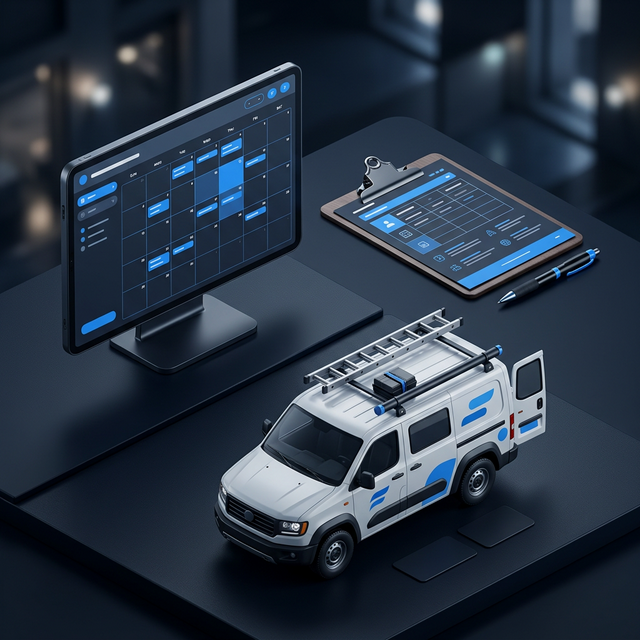
AI dispatch software combines voice AI, intelligent scheduling, and automated routing to handle customer calls, book jobs, and dispatch your crew without human intervention. Service businesses using AI dispatch report 3x more captured after-hours bookings and 60% faster response times.
What Is AI Dispatch Software
Service-based businesses miss an average of 55% of inbound phone calls. After hours, the miss rate exceeds 80%. Every missed call is a lost booking worth $75-$500 depending on the industry. AI dispatch software eliminates these losses by answering every call, booking every job, and dispatching the nearest available worker automatically.
AI dispatch software is not a phone tree, an answering service, or a simple scheduling tool. It is a complete operational layer that sits between your customer and your field team, handling the entire workflow from initial call to job completion.
When a customer calls, the AI answers within 3 seconds, holds a natural conversation to understand their needs, books the job into your scheduling system, and dispatches the best-matched crew member based on location, availability, and skills. The customer receives a confirmation text. Your crew member receives job details and navigation. You receive a completed booking in your dashboard.
The Three Components
AI dispatch software integrates three capabilities that traditionally required separate tools and staff:
1. Voice AI (The Front Door)
The voice AI answers every inbound call with a human-like conversation. It collects the information needed to book the job: what service is needed, the location, any urgency, and contact information.
2. Intelligent Scheduling (The Brain)
The scheduling engine evaluates available workers, current routes, service area zones, and job complexity to assign each booking to the optimal worker and time slot.
3. Automated Dispatching (The Hands)
Once a job is booked, the dispatch system sends the assignment to the worker's phone with job details, customer information, site notes, and GPS navigation.
"It is a complete operational layer that sits between your customer and your field team, handling the entire workflow from initial call to job completion."
Who Benefits Most
AI dispatch software was built for service businesses that rely on phone bookings and crew in the field:
- -Plumbing, HVAC, and electrical contractors
- -Pest control and lawn care companies
- -Waste management and grease trap services
- -Portable toilet rental operators
- -Pet aftercare and animal services
- -Cleaning services (residential and commercial)
The common thread is: your customers call to book, and you send someone to their location. If that describes your business, AI dispatch fits your workflow.
Before and After: The Operational Shift
| Metric | vs | Before AI Dispatch | After AI Dispatch |
|---|---|---|---|
| Call answer rate | vs | 45% | 97% |
| Average answer time | vs | 38 seconds | 2.8 seconds |
| After-hours bookings/month | vs | 8 | 32 |
| Dispatcher labor cost | vs | $3,500/month | $0 (AI handles it) |
The Compounding Effect: Faster response times increase customer satisfaction, which increases referral rates, which increases inbound call volume, which the AI handles without scaling your staff. The operational improvement compounds into revenue growth without proportional cost growth. That is the strategic value of AI dispatch.
Getting Started
Deploying AI dispatch software for a service business takes less than a day:
- Define your service area, pricing, and available services.
- Configure the AI voice persona (tone, language, brand-specific phrases).
- Connect your worker schedule (who is available, when, and where).
- Set up routing rules (geographic zones, skill-based assignment).
- Run test calls to validate the end-to-end workflow.
- Go live and monitor the dashboard for the first week.
There is no hardware to install, no lengthy onboarding, and no ongoing IT maintenance required. The system runs in the cloud and scales automatically as your call volume grows.
Core AI Dispatch Capabilities
| Capability | Traditional Dispatch | AI-Powered Dispatch |
|---|---|---|
| Call Answering | Human receptionist | AI voice agent (24/7) |
| Job Scheduling | Manual calendar entry | Automated with conflict detection |
| Route Optimization | Static daily routes | Dynamic real-time rerouting |
| Customer Communication | Manual calls/texts | Automated SMS updates |
| Performance Analytics | Spreadsheet tracking | Real-time dashboard |
The SBA (Small Business Administration) identifies dispatch automation as one of the top three technology investments for service businesses seeking to scale beyond 10 employees.
How AI Dispatch Works
The entire workflow from customer call to tech notification executes in under 60 seconds without any human intervention.
Getting Started with AI Dispatch
- Define Service Catalog: List every service type, estimated duration, and pricing tier to configure the AI's knowledge base.
- Set Service Areas: Define geographic boundaries using zip codes or radius from your office location.
- Configure Business Hours: Set your standard hours, after-hours, and holiday schedules so the AI adjusts its behavior accordingly.
- Train the AI: Provide sample customer conversations and FAQs specific to your industry vertical.
- Test and Launch: Run 10-20 test calls to validate the AI's responses before routing live customer calls.
For more on measuring the impact, read our guide on Measuring AI Dispatch ROI.
Industry-Specific Applications
AI dispatch software is not a one-size-fits-all solution; the most effective deployments are configured specifically for the operational requirements of each industry vertical. HVAC companies configure the AI to handle emergency heating calls differently than routine maintenance requests, prioritizing same-day dispatch for furnace failures during winter months.
Plumbing businesses train the AI to classify calls by severity, distinguishing between a minor drip and an active water main break that requires immediate P0 response.
How the AI Understands Your Callers
The foundational technology that separates true AI dispatch software from legacy automated phone menus (IVR systems) is the AI language processing engine. An IVR system is inherently rigid; it operates on a strict, predetermined decision tree. "Press 1 for Sales, Press 2 for Service."
If the caller's intent does not align with the pre-programmed options, the system fails completely, creating significant customer frustration.
True AI dispatch relies on deep learning and neural network architecture to comprehend intent, regardless of how the caller phrases things. When a stressed homeowner calls, they do not speak in structured database fields. They speak in chaotic, emotionally charged narratives: "My basement is flooded, the water is coming from the ceiling, and I have a party here in two hours!"
The AI language processing engine instantly dissects this chaotic audio stream. It uses entity extraction to identify the core problem ("flooded basement", "water from ceiling"). It uses sentiment analysis to measure the urgency ("party in two hours").
The engine does not require the caller to press buttons; it deduces that this is a "Priority 1 Plumbing Emergency."
Crucially, the AI language model powering the engine is continuously trained on hundreds of thousands of industry-specific interactions. It understands the colloquial differences between a "slow drip" and a "burst main."
This ability to infer precise operational intent from unstructured, conversational human language allows the software to execute complex logistical commands—routing the closest available emergency tech—entirely autonomously, bridging the gap between human chaos and perfect digital efficiency.
How Low-Latency Processing Eliminates Delay
The operational viability of AI dispatch software in emergency scenarios depends entirely on latency. If a customer speaks to the AI agent, and there is a noticeable three-second delay before the AI responds, the conversational illusion shatters. The customer perceives they are talking to a slow, incompetent robot and will immediately hang up.
To eliminate this latency, advanced dispatch platforms use distributed processing architectures. Traditional cloud computing relies on sending the audio data from the caller's phone to a centralized server farm located thousands of miles away.
The server processes the AI language model, generates the response, and sends the audio back. This physical distance introduces inevitable, unacceptable delays.
Distributed processing solves this by physically distributing the processing nodes. The AI engine is replicated across a large network of localized servers positioned at the "edge" of the network, as close to the geographical location of the caller as possible.
If a customer calls from Seattle, their audio is processed by a Seattle-based server node, rather than a centralized server in Virginia. This significant reduction in physical distance reduces the processing latency to mere milliseconds.
The AI responds with the natural, overlapping cadence of a real human being.
This fast distributed architecture ensures reliable execution of the conversational experience, keeping the caller engaged and ultimately converting them into a booked appointment without ever realizing they are interacting with a machine.
Deployment, Integrations, and Adoption
Modern AI dispatch platforms are accessible to businesses of any size. A solo operator running a one-truck pressure washing business can activate AI dispatch in the morning and begin receiving AI-booked appointments by the afternoon. This same-day deployment eliminates the traditional technology adoption barrier that kept automation tools out of reach for smaller companies.
The integration between AI dispatch software and your existing tools determines how smoothly it fits into your daily workflow. Essential integrations include calendar synchronization with Google Calendar or Outlook, CRM connectivity with platforms like HubSpot or Salesforce, and payment processing through Stripe or Square for deposit collection during the AI booking conversation.
When evaluating AI dispatch platforms, focus on five dimensions: the depth of the AI voice agent's conversational capability, the breadth of scheduling and dispatch automation, the quality of integration with your existing tools, transparent pricing without per-call or per-minute surcharges, and the speed of deployment from sign-up to live operation.
The adoption curve follows a predictable pattern. Early adopters—typically growth-oriented owners comfortable with technology—gain a significant competitive advantage during the eighteen to twenty-four month window before mainstream adoption reaches critical mass.
Late adopters face a harder transition because they must overcome entrenched habits while competing against businesses that have spent years refining their AI workflows. The takeaway: if you adopt AI dispatch today, you're building a competitive advantage that grows stronger with every month of operational data your AI accumulates.
Keep reading: